Vanishing Act
The Automotive Lore Of The Atlantic.

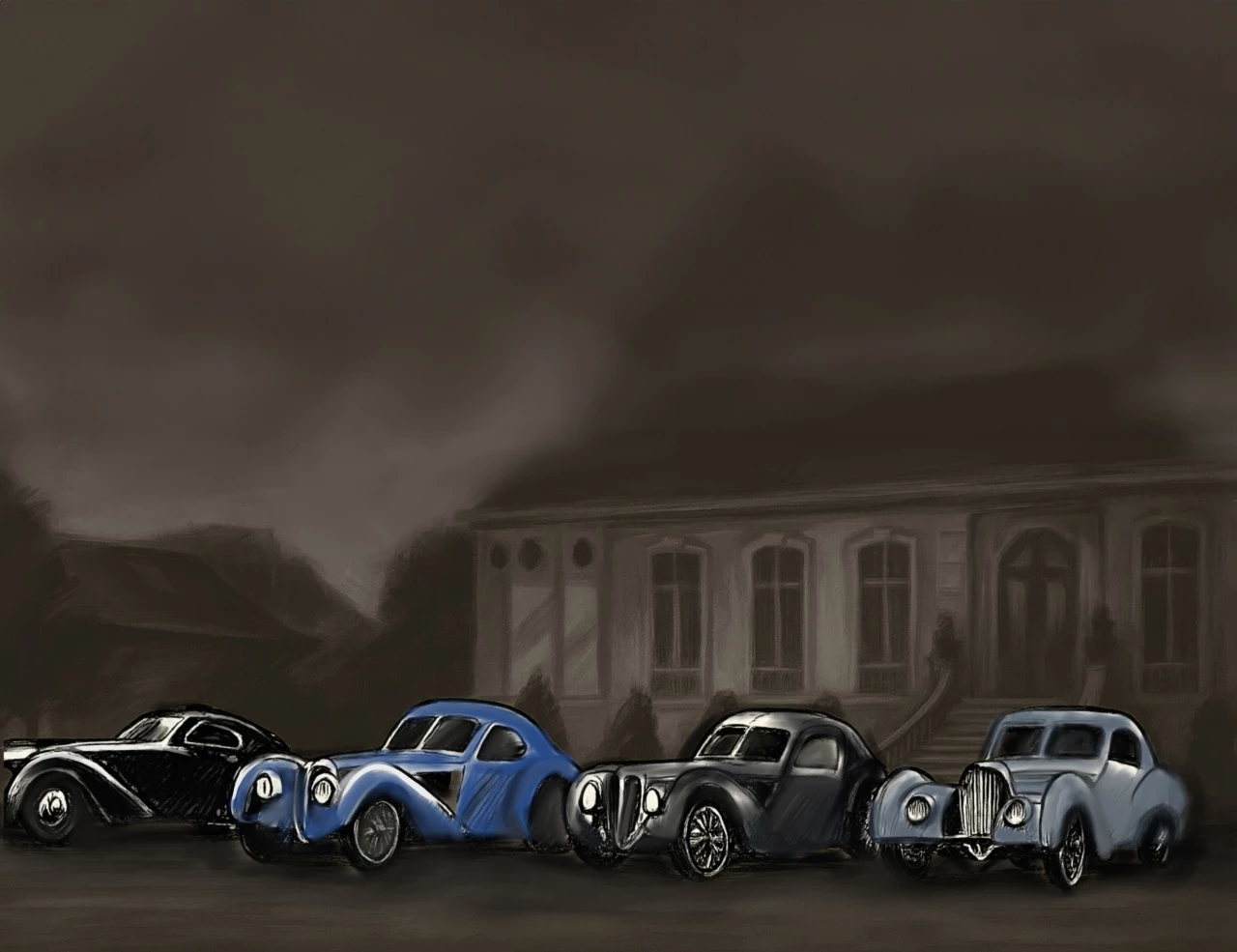
THERE ARE STORIES in the automotive world that border on folklore, tales whispered in the rarified air of concours lawns, exchanged between collectors as one might trade legends of lost empires. Yet few possess the alchemy of fact, myth, and melancholy that surrounds Bugatti’s most enigmatic creation, the Type 57 SC Atlantic known as La Voiture Noire.
A few editions ago in these pages, Etienne Salomé rekindled the embers of this mystery with his reflections on the Atlantic’s sculptural purity. His words reminded us that some automobiles transcend their mechanical nature; they vibrate at the frequency of art. And then, inevitably, the mind returns to the one Atlantic whose absence is more powerful than its presence: the car Jean Bugatti created for himself, a personal poem in aluminium that vanished without a trace in the fog of war.
To speak of La Voiture Noire is to speak of a machine that was not merely built, but composed. Its riveted dorsal seam, its aeronautical spine, its improbable proportions - this was not design but sculptural audacity. When she appeared at the motor shows of Nice and Lyon in the late 1930s, she did so not with the timidity of a prototype but with the confidence of an heirloom already aware of its own destiny. And yet she belonged to no one. As a factory car, she bypassed the usual rituals of registration; she never entered the bureaucratic record that time so often relies upon to keep history honest. In hindsight, this was perhaps her first vanishing act.
By 1940, as Europe trembled and France braced itself against the advancing tide of German occupation, the Bugatti family understood that the treasures of Molsheim could not remain in place. Engines, prototypes, artistic blueprints, delicate research - everything that carried within it the spirit of Ettore Bugatti’s genius - had to be moved. La Voiture Noire was among them. She was reportedly loaded aboard a train destined for Bordeaux, a vessel meant to ferry her out of danger. And then, somewhere between intention and arrival, she disappeared into history’s blind spot.
What followed is one of the most complete silences in automotive lore. No railway ledger confirms her arrival. No letter mentions her condition. No dockworker recalled seeing such a creature roll onto the platform in Bordeaux. A car so extraordinary it stopped conversations at motor salons seemed to evaporate like mist on a windshield.
In the decades since, historians, collectors, and dreamers have tried to impose narrative upon that void. And so the theories were born. Some imagine her destroyed in the chaos of war - perhaps consumed by flames during an air raid, her aluminium body melting into a shapeless memorial to lost artistry. Others speak in hushed tones of barns in rural France, of stone cellars in Belgium, of private estates in the Basque Country where the descendants of those who once sheltered wartime treasures might still hold a secret too precious to reveal.
More cynical voices believe she may have been dismantled - her body scrapped, her components cannibalised during the war effort. A theory too bleak to contemplate, yet too plausible to dismiss. And then there is a final possibility, born of the chaos that reigned in occupied France: that German officers, aware of the car’s value, intercepted her during transit and spirited her away into the labyrinthine world of seized art and spoils. That possibility lingers, unresolved, in the annals of wartime appropriations.
While La Voiture Noire remains an apparition, the surviving Atlantics continue to shape the imaginations of those fortunate enough to encounter them. One sits in Oxnard, California, at the Mullin Automotive Museum, loved and curated like a piece of kinetic sculpture. Another - miraculously resurrected after a catastrophic train accident in 1955 - disappears periodically from view, as discreet collectors tend to allow their treasures to do. And the most celebrated, owned by Ralph Lauren, stands as a modern icon: immaculate, mysterious, and perhaps the closest we may ever come to understanding the artistic audacity of the one that is missing.
But the true power of La Voiture Noire lies in her absence. She represents the irresistible intersection of hope and uncertainty, what the French so beautifully define as la nostalgie du possible - nostalgia for what might yet be. Her myth endures not because she is lost, but because she might still be found.
Imagine, for a moment, the consequence of such a revelation. The automotive world would erupt. The headlines would circle the globe before the dust had settled in the barn where she was found. Collectors would speak of nothing else; auction houses would feel the tremor of a seismic shift. Valuers would whisper numbers not merely in the tens of millions, but in the hundreds. And lawyers - those tireless choreographers of modern disputes - would begin their meticulous dance, each representing a different claimant: the finder, the Bugatti family, the Volkswagen Group, perhaps even the French state. Who, after all, owns a myth?
Then would come the scholars, the metallurgists, the conservators, the artisans. Should she remain frozen in the state in which she was found - dust-covered, time-bent, her scars speaking of her decades in the wilderness? Or should she be restored to her 1937 splendour, as she appeared under the gaze of a proud Jean Bugatti?
Such debates would not be mere technicalities; they would be philosophical in nature. How do we honour an object whose very essence is intertwined with loss, silence, and imagination?
And yet, if I may indulge an immodest but gentle dream - one shaped not by the machinery of markets or institutions but by the quiet poetry of possibility - we might imagine something else entirely. Imagine that all claims, all ownerships, all legalities momentarily fell away. Imagine that, for one miraculous instant, practicality yielded to romance. That the three surviving Atlantics were brought together with the fourth, newly rediscovered, in a place far from crowds, cameras, and collectors.
Picture them at dawn, the air still cool, the horizon painted with the first strokes of morning. Four silhouettes in a line - sinuous, improbable, defiant of time. Engines stirring awake, metal contracting and expanding like living breath. And then, with the slightest motion, setting off together in a quiet procession, four sisters reunited after nearly a century of separation. No auction paddles. No press releases. No spectacle. Just the pure, unadulterated joy of movement - the thing Jean Bugatti himself loved most.
This is, perhaps, the ultimate luxury - not possession, but imagination. The ability to dream of a past that might still return, and of a future that still has space for wonder. And so La Voiture Noire remains exactly where she has always been: somewhere between history and legend, her absence shaping her destiny as surely as her presence once did.
As long as she remains unfound, she belongs to all of us. And perhaps that, in its own quiet way, is the most beautiful ending she could ever have.
The views and opinions expressed herein are the views and opinions of the author and do not necessarily reflect those of The Monegasque™.
Disclosure: The Monegasque™ enhances the editing process with the help of carefully selected AI tools. These tools provide valuable support without taking over the editing process completely, ensuring that the final product is the result of human creativity and expertise augmented by the benefits of enhanced technology. This article is protected under the copyright of The Monegasque™. Unauthorized reprinting, republishing, or rewriting of this content is strictly prohibited without explicit permission from The Monegasque™. Quotations from this material are permissible provided that a direct link to the full article on The Monegasque™ is included.