The Innovation Dividend
Geopolitics Aside, Energy Is On The Move.

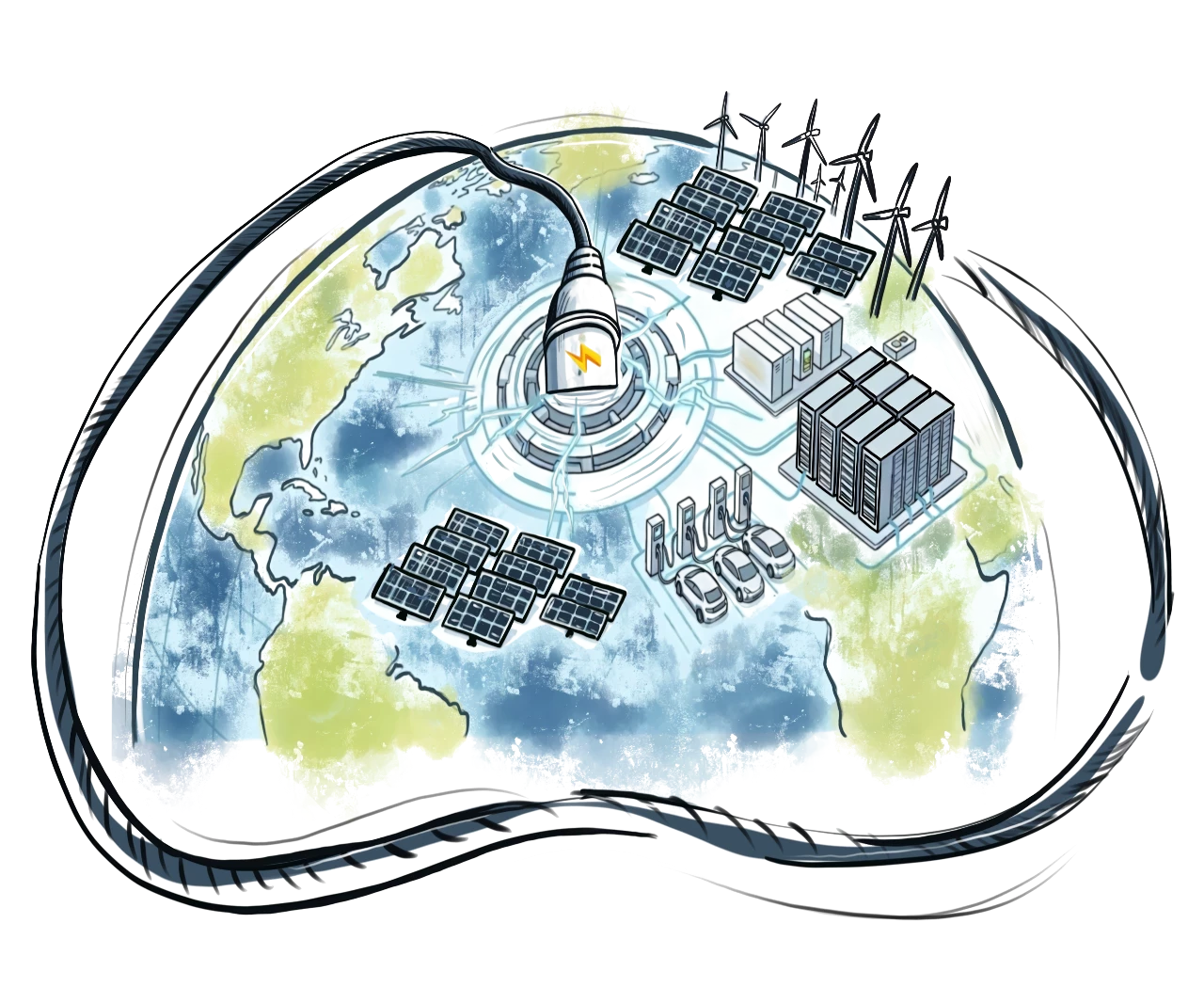
CLIMATE CHANGE AND climate policy have been sidelined in public debate for a while. These days, geopolitics and the erratic and confrontational U.S. administration dominate the news and capture our attention. This is not all bad, however, as it brings some benefits. A cynic might argue that when attention shifts elsewhere, the risk of excessive activism and interference diminishes, allowing things to evolve naturally, with fewer political disturbances. The energy transition has become a sustainable force - a tectonic shift with momentum - driven by attractive economics and rapid innovation. Consequently, dependence on policy support is decreasing.
This shift is evident in many places, but perhaps most notably in the U.S. After more than a year of a government friendly to fossil fuels, the reality on the ground tells a very different story in some parts. Investments in renewables reached a record high last year, with solar power plants and grid storage batteries booming. Data centers are indeed increasing power demand after years of stagnation, but so far, this growth is being offset entirely by renewables, with no increase in fossil fuel use. Of course, the U.S. is a vast country and trends vary regionally. The combination of solar panels and scalable grid storage batteries in the size of shipping containers offers an economically attractive solution in terms of costs, time to market and reliability, which explains the investment boom.
While Europe remains more advanced than the U.S. in energy transition, the dynamics are changing more broadly. The shift to plug-in vehicles - battery electric and plug-in hybrid cars - regained momentum last year with the market share of plug-ins climbing from below 25% to almost 30% in Europe. Overall, auto sales are stagnating rather than growing, leaving observers wondering what is holding them back. Consumer confidence is robust, having recovered from the lows of the post-pandemic inflation shock. There may be structural forces at play that create obstacles, such as decreasing car ownership, demographics, and an ageing population, which could make consumers hesitant to buy cars amid the technological shift towards plug-ins.
Sometimes it is worthwhile to take a step back and look at the big picture. The automotive market has changed drastically since the beginning of the decade - less than six years ago. Plug-in vehicles have become standard offerings, with the latest models costing the same as their combustion engine counterparts. In terms of driving performance, plug-ins leave their fossil-fueled siblings in the dust. Having observed different technological and innovative phases for some time, we have a high conviction that plug-ins follow the well-known S-curve adoption rate. The dynamics behind such an S-curve include fast-paced innovation, ever-greater convenience (such as driving range and charging speed in the case of plug-ins), ever-lower costs as manufacturing scales up, and ever-decreasing hesitation, even among those who are averse to change and tend to be late adopters, as the product becomes ubiquitous. By 2030, most buyers should opt for a plug-in as models will be available to suit almost any individual need.
In such an environment, the key policy measure is openness, allowing innovation to flourish. Subsidies or other capital-focused support measures have become redundant. The United Kingdom offers some noteworthy lessons in this regard. Unlike the European Union, it does not levy any tariffs or minimum pricing rules on Chinese cars, so consumers have a wider selection of low-priced plug-ins to choose from. Consequently, plug-in market shares in the UK exceed those in Germany and France by more than 5%. Chinese brands hold market shares of between 10% and 15% in the United Kingdom, compared to below 5% in core continental markets - up from negligible levels earlier this decade.
Is this a threat, as some fear? Chinese car manufacturers not only export, but also set up shop in Europe. Economically, it does not matter which brands manufacture cars in Europe. However, Europe could benefit tremendously from the transfer of know-how and innovation obtained from factories operated by Chinese car manufacturers. Most of these companies are currently setting the benchmark in terms of product technology and manufacturing efficiency. One of Europe's core strengths still is its competence to manufacture quality products, and this does not discriminate between the employment by European or Chinese companies. This openness is likely the key advantage over the U.S., which takes a hostile approach to China. The U.S. may be leading the way in many of today's popular innovations, but it has lost touch with the leaders in electric mobility. While there are a few newcomers, one of which seems to have shifted its attention to space and artificial intelligence rather than electric cars, the incumbent U.S. car manufacturers appear to have lost the race for electric mobility technology. Competition from outside will only grow, as plug-ins become an increasingly convenient and economical solution for U.S. buyers. Plug-in vehicles are a perfect fit for the U.S. lifestyle of daily commutes and (charger equipped) single-family homes. Having lost the Chinese market, which was the cash cow that made some German car manufacturers rich and complacent, the U.S. may offer an attractive opportunity to compensate for losses in global market share going forward.
Much is happening within this transition, but two trends deserve particular attention. A self-centric view is partly natural and requires special efforts to be challenged. From a European perspective, this means taking a closer look at emerging markets, particularly in Southeast Asia. In this region, all aspects of economic growth are pronounced, supported by demographics and wealth creation. It is one of the few regions that is seeing rising demand for the resources needed to build infrastructure, such as metals and minerals, and for fossil fuels to fulfill mobility needs. However, it would be wrong to assume that emerging economies will follow the same pathways as developed economies. Instead, they leapfrog. First-time car buyers in countries such as Vietnam and Indonesia do not want to settle for second-best technology. Thanks to domestic car manufacturers focusing on electric mobility or the influx of popular Chinese models, the market share of plug-in cars is rising swiftly. Although the data is patchy and unreliable, there are indications that plug-in market shares are approaching 50% in Vietnam and around 20-30% in the rest of Southeast Asia, up from negligible levels less than five years ago. The momentum in emerging markets seems stronger than in the Western world.
Meanwhile, China is powering ahead with road electrification. China accounts for almost one in three cars sold globally. Considering that more than half of these are plug-in vehicles, China's dominance in the plug-in supply chain, including battery manufacturing, should come as no surprise. Innovation remains exceptionally fast-paced, not in spite of, but perhaps because of the ongoing consolidation. Plagued by overcapacity, China's auto industry faces fierce competition and low profits. Progress in battery technology is far from over and continues to make further leaps forward. Different chemistries and optimized structures are increasing energy density, packing efficiency and charging speeds. After years of somewhat disappointed optimism, solid-state batteries are incrementally moving towards commercialization. Recently, one of China's leading car manufacturers unveiled its latest battery technology, seemingly setting a new standard for convenience. It offers a driving range of over 800 kilometers and charging speeds of just a few minutes, all without adding excessive weight.
Today's geopolitics creates a lot of temporary noise and distracts from fast-paced innovation. However, this innovation brings about more significant tectonic shifts that are becoming increasingly visible. For example, Chinese oil demand has probably peaked, and energy imports, including liquefied natural gas from overseas, have stagnated, if not declined. The opportunistic purchase of low-priced oil from Russia or Iran has obscured these structural trends, which stem from the boom in plug-in cars, solar power plants, and grid storage batteries. These shifts benefit Europe in various ways, reducing energy dependency and lowering energy expenses. Of course, this promise requires pragmatic policymaking instead of constraining it, and respecting, but not fearing, the voices that want to conserve. These shifts are also visible in energy prices. Despite the perception of all-dominant geopolitics and before the Iran war escalation, oil and natural gas prices have traded below the levels seen in the last decade, particularly between 2010 and 2015, and this is even without adjusting for inflation in the case of oil. Investors have always fared better by trusting in innovation than by fearing geopolitics.
"In Monaco, where sustainability converges with cutting-edge ambition, the rise of electric mobility reflects a global transformation driven not by policy edicts, but by relentless innovation - a shift mirrored in Julius Baer’s proactive partnership with clients navigating this dynamic landscape. Just as the bank champions the fusion of finance, technology, and environmental responsibility through its support of Formula E, it also empowers investors to decide the accelerating energy transition. With plug-in vehicle adoption surging worldwide - fueled by breakthroughs in battery technology, competitive markets, and leapfrogging in emerging economies - the mobility revolution is rewriting energy economics. Amidst geopolitical noise, these deep-seated trends reveal a truth: the future runs on electricity. At Julius Baer, insight meets action - we don’t merely observe this evolution; we help clients anticipate, adapt, and thrive within it, turning transformative momentum into informed investment strategies."
— Albert Henriques Pascual, Chief Executive Officer, Bank Julius Baer Monaco
https://the-monegasque.com/en/article/mind-over-movement
The views and opinions expressed herein are the views and opinions of the author and do not necessarily reflect those of The Monegasque™.
Disclosure: The Monegasque™ enhances the editing process with the help of carefully selected AI tools. These tools provide valuable support without taking over the editing process completely, ensuring that the final product is the result of human creativity and expertise augmented by the benefits of enhanced technology. This article is protected under the copyright of The Monegasque™. Unauthorized reprinting, republishing, or rewriting of this content is strictly prohibited without explicit permission from The Monegasque™. Quotations from this material are permissible provided that a direct link to the full article on The Monegasque™ is included.