The Compliance Trap
Why More Rules Make For A Lesser World.

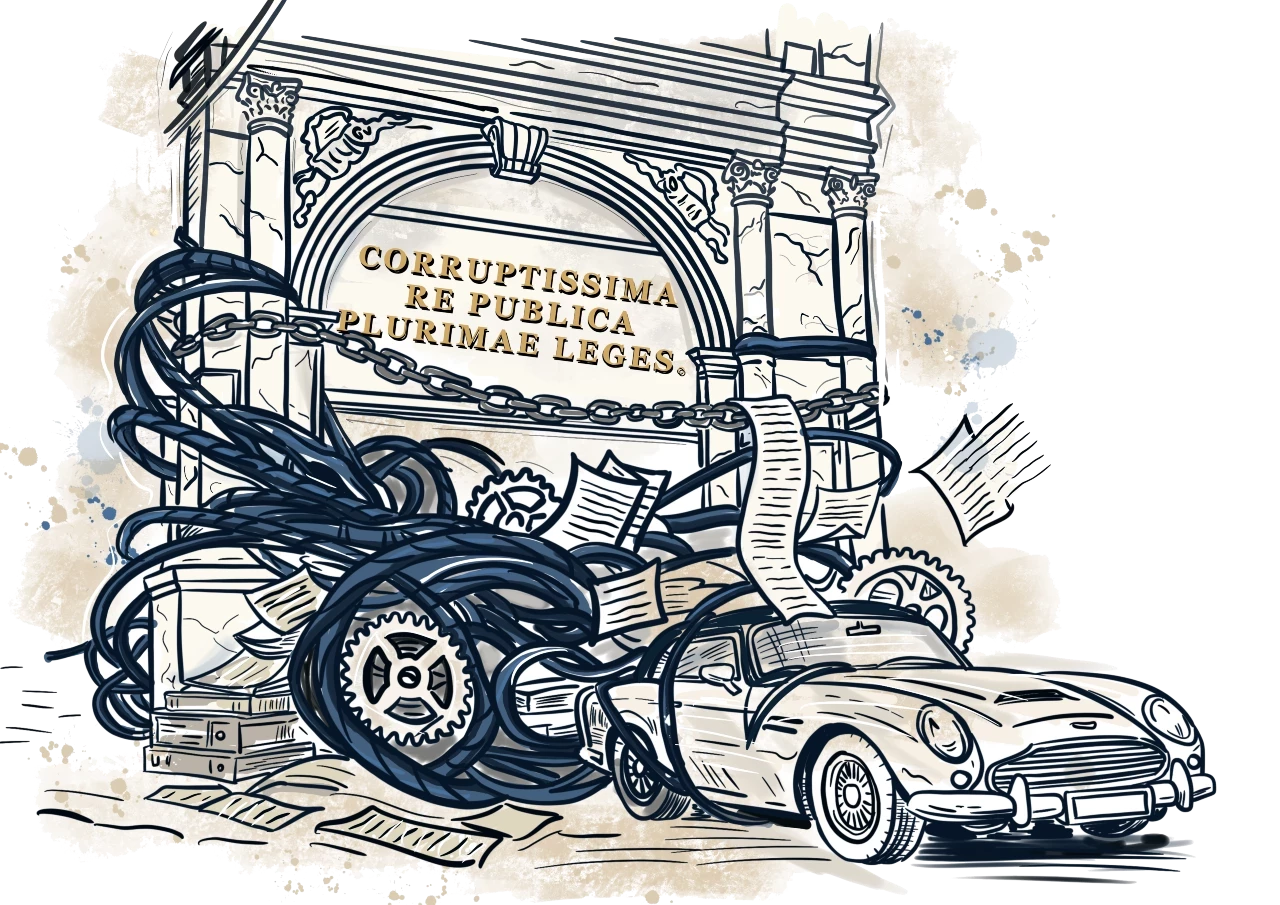
ON ONE OFTEN HEARS that rules are the shield of the common man, the sturdy barricade protecting us from the caprice of the powerful and the chaos of the marketplace. But as we navigate a modern world increasingly defined by a stifling inflation of mandates, a weary skepticism has begun to take root. Two thousand years ago, the Roman senator Tacitus identified the rot at the heart of this impulse: Corruptissima re publica plurimae leges. The more corrupt the state, the more numerous the laws.
In our era, this "corruption" is rarely as crude as a bribe. Instead, it is a decay of institutional trust - a belief that unless every human interaction is codified, audited, and rubber-stamped, it is inherently dangerous. We have fallen into a compliance trap, and the cost of our perceived safety is the slow erosion of our dynamism.
Consider the current state of global finance. We have reached a point of "compliance hegemony" where the simple act of opening an account or moving capital has morphed into an expensive, multi-week odyssey of red tape. While these layers of bureaucracy are sold as a defense against dark money, a significant positive impact on the industry's integrity has yet to be found. Instead, banking has simply become slower, more expensive, and less performant for the end client. We have built a fortress so secure that the people it was meant to house can no longer get through the front door.
The automotive industry offers an even more visceral cautionary tale. In a well-intentioned rush to legislate a greener future, the European Union pushed an "all-in" mandate for electric vehicles. While the EV is a triumph of engineering and a perfect solution for many, true optimization requires a wide-angle lens, not a blindfold. By imposing a single, rigid framework on an entire continent, regulators ignored the complexities of consumer reality and global supply chains. The price of this regulatory hubris? A staggering 65 billion euros in depreciations for European carmakers last year alone. Ouch, indeed. That isn't progress; it is a self-inflicted wound born of the belief that innovation can be mandated by decree.
Yet, we know that rules do not have to be cages. When the United States Constitution was drafted, it replaced the flimsy, chaotic Articles of Confederation with something revolutionary: a formal but remarkably simple structure. It did not seek to micromanage the lives of its citizens; instead, it established a clear separation of powers and a system of checks and balances. This was a framework, not a fetter. It provided the stability and durability that allowed a diverse set of states to unite, creating the floor upon which a new nation could build, innovate, and eventually lead.
This is the distinction we have lost. There is a fundamental difference between a rule that limits and a rule that empowers. One smothers human creativity under a blanket of "thou shalt nots"; the other provides the predictable arena in which that creativity can thrive.
We are currently choosing the former, trading our potential for a false sense of security. But there is a path out of the trap. If we return to the idea of rules as frameworks - as the simple architecture that allows for complex human achievement - we might find that the world becomes not just safer, but significantly greater. That, after all, is the only kind of protection worth having.
The views and opinions expressed herein are the views and opinions of the author and do not necessarily reflect those of The Monegasque™.
Disclosure: The Monegasque™ enhances the editing process with the help of carefully selected AI tools. These tools provide valuable support without taking over the editing process completely, ensuring that the final product is the result of human creativity and expertise augmented by the benefits of enhanced technology. This article is protected under the copyright of The Monegasque™. Unauthorized reprinting, republishing, or rewriting of this content is strictly prohibited without explicit permission from The Monegasque™. Quotations from this material are permissible provided that a direct link to the full article on The Monegasque™ is included.