Long-Term Survival
How The Napier Workshop That Once Struck Coins For The Royal Mint Became The Firm That Broke Land, Air, And Water Speed Records—And Nearly Didn't Survive Its Own Genius.

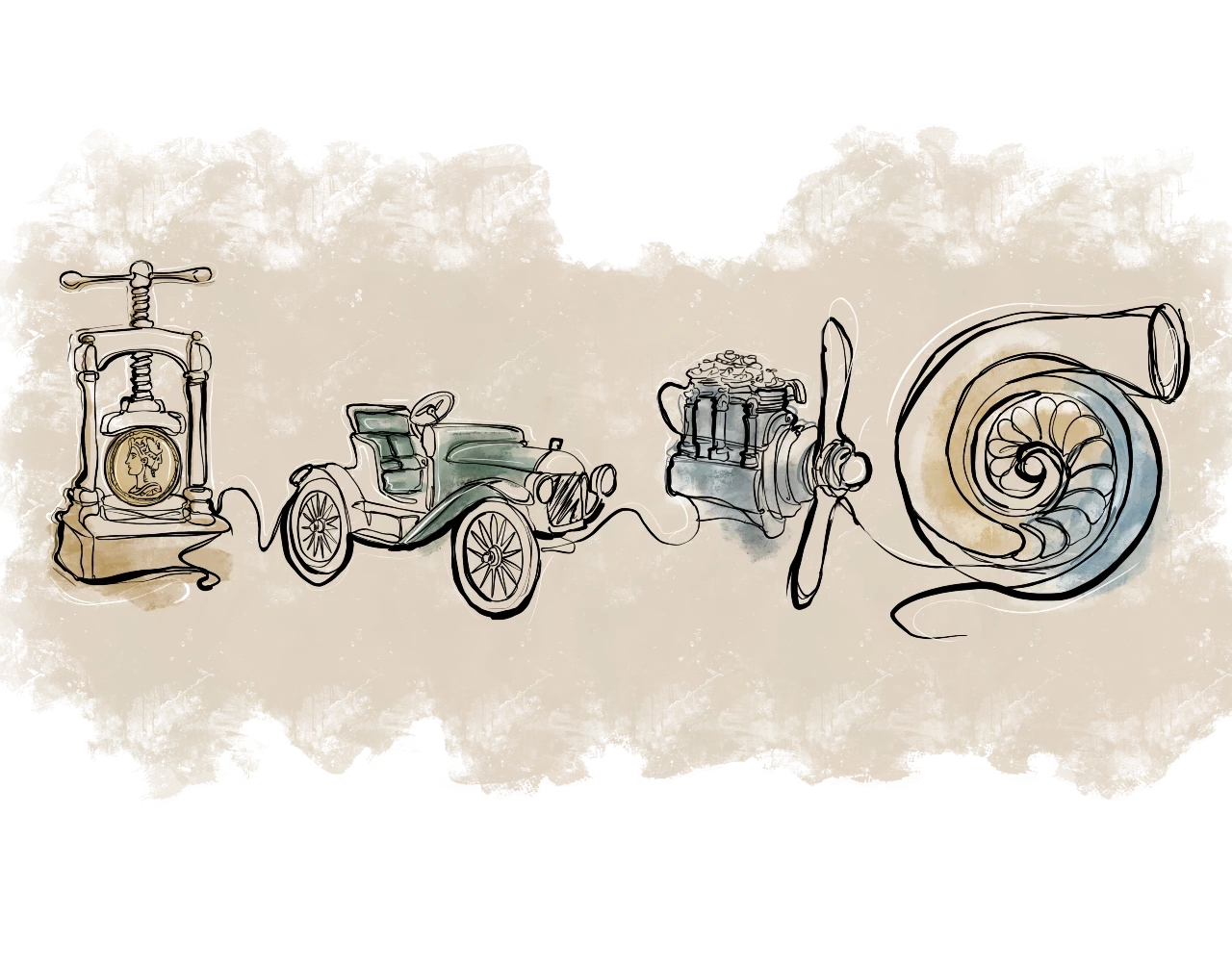
THERE IS A PARTICULAR species of British firm whose survival across two centuries owes less to any single triumph than to a kind of institutional restlessness—an inability to sit still, to specialize too narrowly, to be satisfied. Napier is that firm. It has made banknote presses and bullet machines, taxicabs and torpedo boats, the fastest cars on Earth and the engines that carried them there, jet-age turboprops and diesel aircraft engines decades before either seemed a sensible idea. It has been brilliant and it has been broke. It has been family-owned, publicly listed, absorbed by conglomerates, spun free by its own management, and finally folded into an American industrial giant. Through all of it, one thread holds: excellence as the only reliable currency of longevity.
The story opens in 1808, when David Napier established a workshop devoted to precision manufacturing—an unglamorous foundation, on paper, for a company that would one day chase speed records across three elements. Napier built printing machinery, hydraulic presses for the engineer Isambard Kingdom Brunel, and, more curiously, the machinery used to strike coins for the Royal and European Mints and to manufacture musket balls with unprecedented accuracy.
In 1824, David's own cylinder press design—nicknamed the "Nay-Peer"—was made famous by Thomas Curson Hansard, the official printer of the British Parliament. The firm won medals at the Great Exhibitions of 1851 and 1861. This was a company, from its very first decade, defined by exactitude: the capacity to make things that had to be precisely right, whether the object was a coin, a banknote, or a bullet.
But precision alone does not guarantee survival, and Napier's own history supplies the proof. James Napier, who took charge of the firm in 1867, was by every account a gifted and inventive engineer, capable of the most delicately crafted machinery for coining and printing. He was, by the same accounts, a poor businessman. By 1895, the once-thriving workshop employed as few as seven people, and the family's premises on York Road had fallen into visible disrepair. It is the first of the story's two great lessons, delivered a century before either would be needed: brilliant engineering, left unmanaged, is not a business—it is a hobby with better tools.
Salvation arrived, as it so often does, through a second generation with a different temperament. Montague Napier, James's son, inherited the firm on his father's death and found in Selwyn Francis Edge—a manager poached from the Dunlop Tyre Company—the commercial partner the business had always lacked. Together they transformed a struggling engineering workshop into a motor manufacturer of real consequence. In 1900, Napier built its first car; in 1902, S. F. Edge drove a Napier to become the first Englishman to win an international motor race, the Gordon Bennett Trophy, between Paris and Innsbruck. Car production climbed toward 700 vehicles a year, and Napiers were soon a familiar sight in the London taxi trade.
The firm's appetite for speed was not confined to the road. In 1903, a Napier-built launch, driven by the pioneering motorist Dorothy Levitt, won the inaugural Harmsworth Trophy for speedboats at Cork Harbour—a marine record that announced, early, a pattern that would recur across the century: whatever the medium, Napier wanted to be fastest through it.
The First World War redirected the company's genius toward the air. Early contracts to build other manufacturers' aero engines proved unsatisfactory, and in 1916 Napier resolved to design its own. The result was the Lion—a 12-cylinder, W-block engine that became, by any measure, one of the most successful aero engines ever built. Between 1916 and 1926 it powered more than 160 different aircraft types worldwide and went on to set records in the air, on land, and on water, a triple crown few engines before or since have claimed. A Lion-engined seaplane took the air speed record to 336.3 mph in 1929; on land, Lion-powered cars—most famously the Golden Arrow—pushed the land speed record past 230 mph the same year and kept climbing through the 1930s, ultimately reaching 394.196 mph in 1947. On water, a Lion engine claimed the water speed record in 1932.
No single machine captures the era's spirit better than the Napier-Railton, the aero-engined racing car designed by Reid Railton for the driver John Cobb in 1932. At Brooklands, it set an all-time lap record—143.44 mph—in 1935, a record that stands to this day in perpetuity, since the circuit itself fell silent during the Second World War and was never again used for racing. It is, fittingly, a record that can now never be broken, only remembered.
By the 1930s, Napier's engineers were already reaching past convention. In 1933, the company license-built the Culverin—a version of the Junkers Jumo 204 diesel aircraft engine—putting a diesel powerplant into the air at a time when the very idea seemed eccentric to most of the industry. Out-of-the-box thinking was, by now, simply how Napier worked. The Second World War called forth the firm's most formidable piston engine: the Sabre, a 24-cylinder, H-block, sleeve-valve design of extraordinary ambition, developed under Major Frank Halford. Early versions produced around 2,200 horsepower; by war's end, late prototypes were reaching 3,500 hp, among the most powerful piston aero engines the world has known. The refined Sabre V, delivering a consistent 2,400 hp, powered the Hawker Typhoon and its formidable successor, the Hawker Tempest.
Napier's postwar decade produced two of its most singular engines—and two lessons in the limits of pure ingenuity. Asked by the Royal Navy to build a diesel engine for patrol boats, Napier's engineers arranged three of their existing Culverin units into a triangular configuration to create the Deltic: one of the most mechanically complex engines of its day, and one of the most reliable. The Deltic served in torpedo boats and minesweepers before finding an unexpected second life as a locomotive powerplant in British Rail's Class 55—proof that Napier's engineering, even when its markets shifted beneath it, kept finding new work to do.
The Nomad, meanwhile, was arguably Napier's most brilliant and most poignant creation: a turbo-compound design marrying a diesel engine to a turbine to recover energy otherwise lost to the exhaust, achieving the best specific fuel consumption of any aircraft engine—a record that, remarkably, still stands. And yet the market had already moved on; jet engines flying at higher altitudes could achieve comparable economy more simply, and the Nomad, for all its brilliance, was cancelled. It is the story's second great lesson, engineering's answer to James Napier's commercial failure eighty years earlier: even flawless invention can be defeated by timing, by a market that wants something else, or wants it delivered differently.
By 1961, with Deltic sales winding down and no new engine on the drawing board to replace it, Napier's aero-engine business was transferred to Rolls-Royce. The great engine-building chapter of the firm's history had closed. What followed was quieter but no less consequential: a shift toward turbocharging technology for marine, power-generation, and rail applications, a field in which precision engineering—Napier's oldest inheritance—mattered more than horsepower records. The company passed through the hands of Siemens Power Generation, until, in June 2008, its management bought the business back, restoring Napier's independence for the first time in decades. It was a short-lived autonomy: in February 2013, Napier Turbochargers was acquired by Wabtec Corporation, under whose ownership it operates today, as in its own description, a world leader in the design, manufacture, and support of industrial turbochargers.
Two hundred years condensed into a single company reveal something more useful than nostalgia. Napier's endurance was never a matter of one perfect product or one visionary founder; it was a matter of repeated re-founding, generation after generation, each time requiring both an engineer bold enough to defy convention and a businessperson disciplined enough to keep the lights on. James Napier's genius nearly extinguished the firm; Montague Napier's genius, paired with Edge's commercial instinct, revived it. The Nomad's brilliance could not, alone, save it from a market moving in another direction. The lesson repeats until it becomes unmistakable: innovation explains why a company deserves to survive, but it is never, by itself, why a company does survive.
Which suggests a broader principle, one that outlasts turbochargers and Land Speed Records alike. Long-term success is not the product of a single kind of excellence, however dazzling. It is the product of at least two: the entrepreneur who recognizes a venture's potential but cannot build the thing itself, and the engineer who is unbound by compliance, cost sheets, or convention, and so is free to imagine what has not yet been built. Neither is sufficient alone. Together, held in the same enterprise across two centuries, they are the whole of the magic—the peculiarly human trick of combining different gifts into something that outlives any one of the people who supplied them.
With thanks to my daughter Zita, whose question about the Napier-Railton set this whole inquiry in motion.
SOURCE AND IMAGERY: NAPIER TURBOCHARGERS—HERITAGE (NAPIER-TURBOCHARGERS.COM/HERITAGE)
The views and opinions expressed herein are the views and opinions of the author and do not necessarily reflect those of The Monegasque™.
Disclosure: The Monegasque™ enhances the editing process with the help of carefully selected AI tools. These tools provide valuable support without taking over the editing process completely, ensuring that the final product is the result of human creativity and expertise augmented by the benefits of enhanced technology. This article is protected under the copyright of The Monegasque™. Unauthorized reprinting, republishing, or rewriting of this content is strictly prohibited without explicit permission from The Monegasque™. Quotations from this material are permissible provided that a direct link to the full article on The Monegasque™ is included.