Endless Sun-Days
The Psychological Isolation Of Xevi Solà.
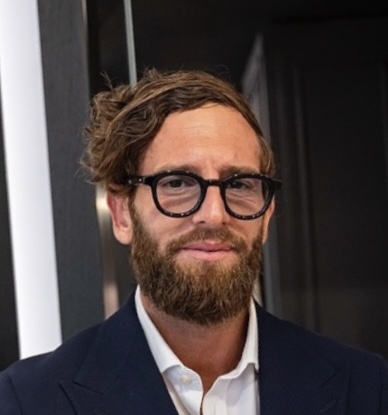
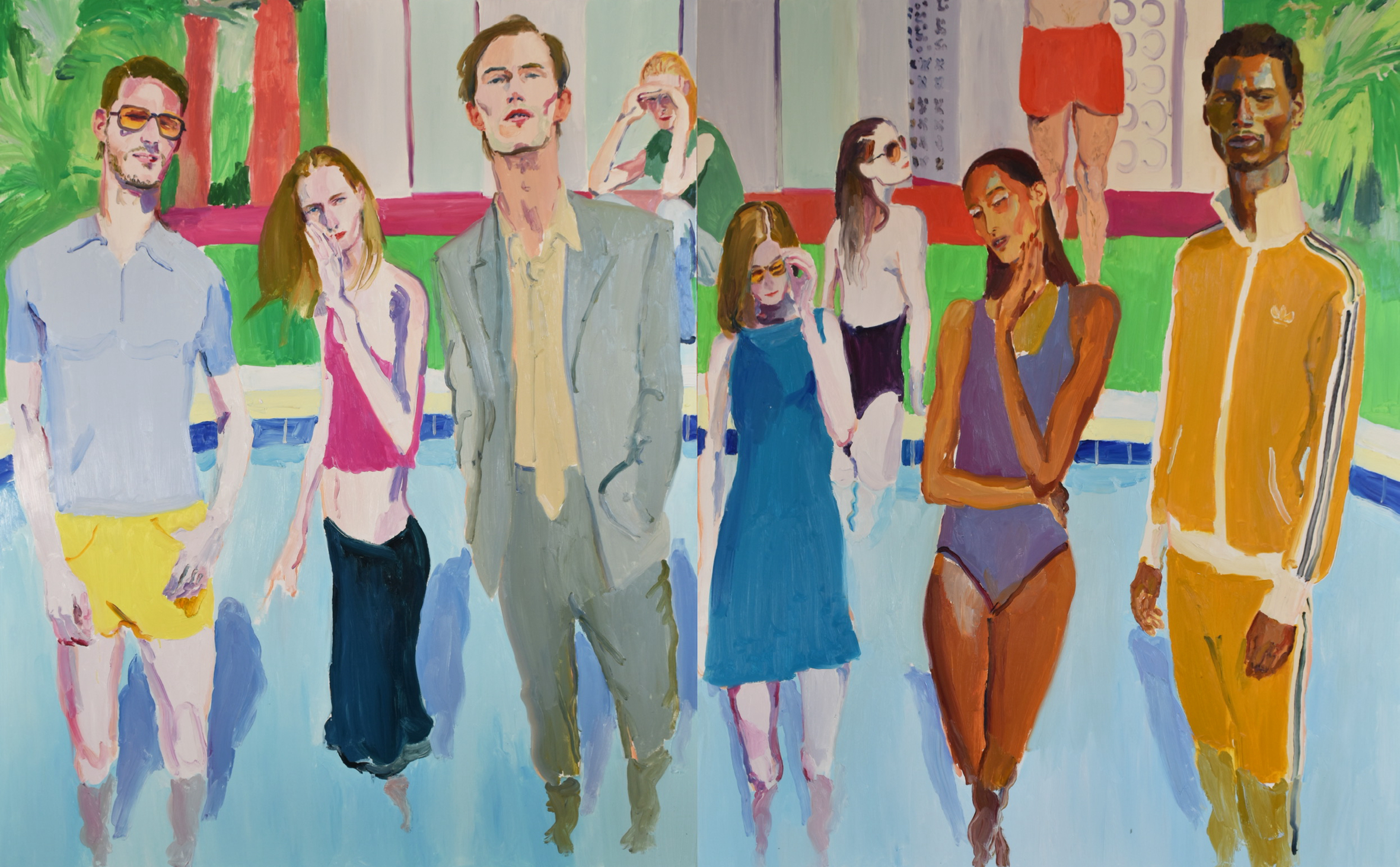
AT THE CENTER of Xevi Solà’s paintings is a familiar summer scene - and an unfamiliar sense of unease. A swimming pool glimmers in the sun, bodies linger at its edge, and time appears to stall. In Endless Sun-days, Solà’s first solo exhibition in New York, debuting at Opera Gallery this February, the Spanish artist presents scenes of leisure that unfold into subtle emotional dramas, charged with introspection beneath their luminous surfaces.
Comprising fifteen new paintings, the exhibition places viewers in settings that feel instantly familiar: young people sunbathing beside a pool, lingering over brunch in a garden, or reclining in moments of shared idleness. Yet these scenes resist the comfort typically associated with leisure. Rather than offering uncomplicated pleasure, Solà’s work reveals a more complex emotional terrain, where brightness and beauty coexist with unease and restraint. His figures appear paused in time, as if caught mid-thought, their emotions simmering just beneath the surface.
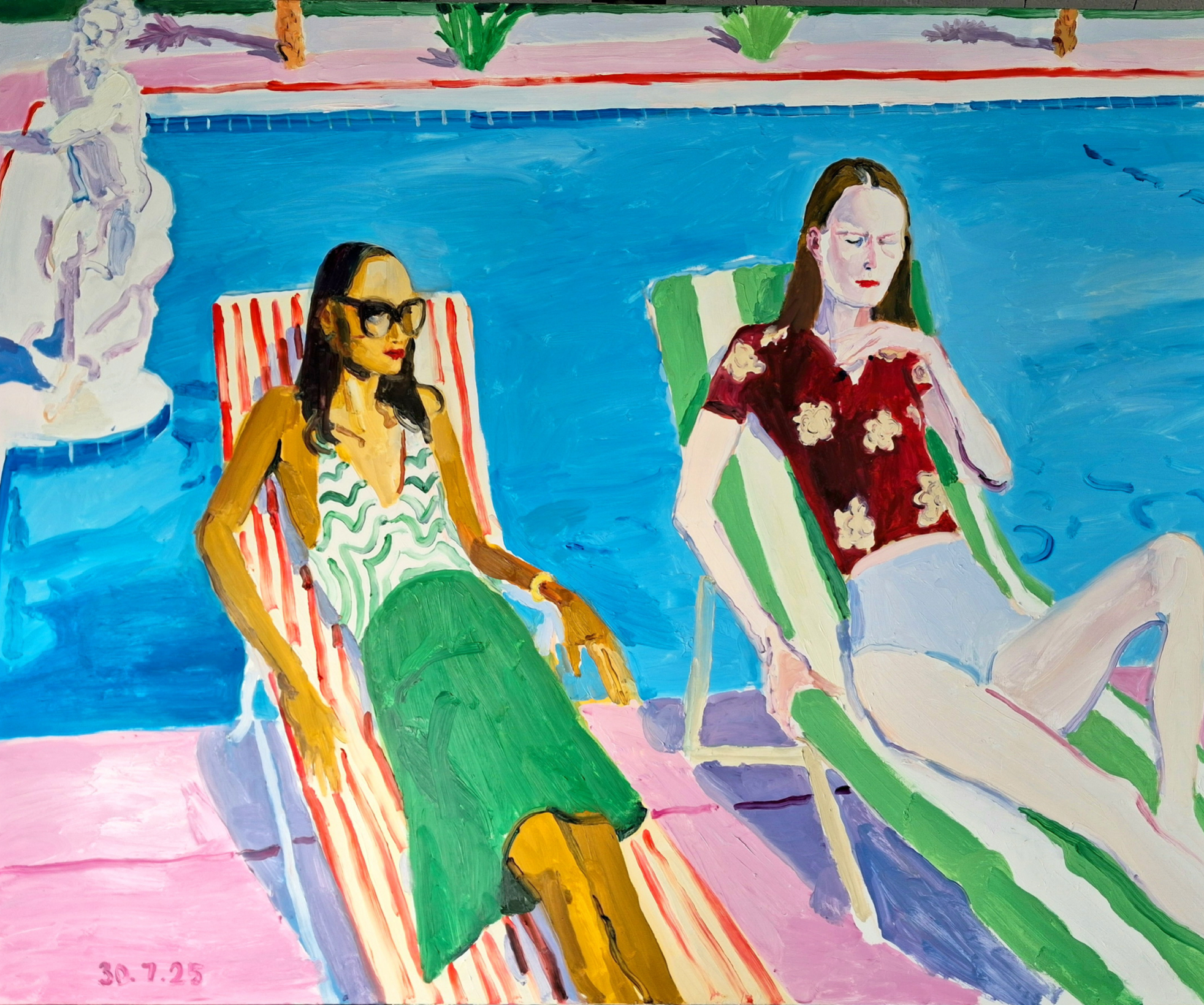
Solà draws from an eclectic range of visual sources, including fashion photography, mugshots, and Hollywood cinema. These references influence portraits that feel at once staged and deeply human. “If I had to define this series,” Solà explains, “I would say it’s a kind of collective psychological portrait. These figures are trying to relax in a bright and colorful environment, but grey clouds lurk behind their sunglasses.” Each painting functions as an invitation, prompting the viewer to imagine what preceded the scene and what might follow once the stillness breaks.
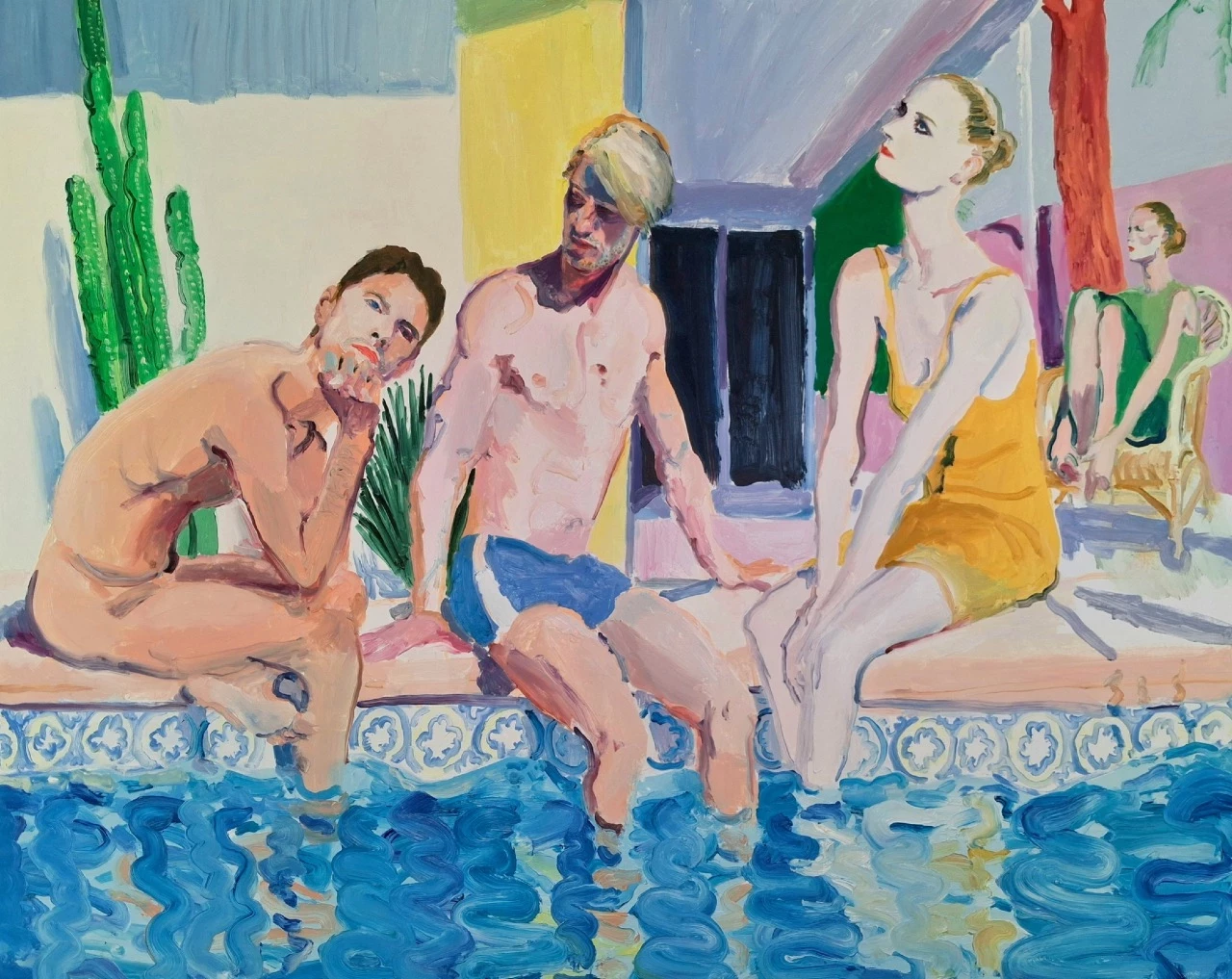
A key work in the exhibition, Dimanche 1 (2025), encapsulates the emotional register of the series. Four young figures lounge beside a sunlit swimming pool, their feet immersed in the water. Although they share the same physical space, each appears psychologically isolated, absorbed in private thought. There is no overt interaction or dramatic gesture - only a silence weighted with implication. Time seems suspended, as if the scene were held between breaths. The painting subtly nods to David Hockney’s iconic swimming pool imagery, with its clarity of light and emphasis on leisure. Yet where Hockney often celebrated openness and pleasure, Solà introduces ambiguity, allowing introspection and doubt to permeate the brightness of the setting.
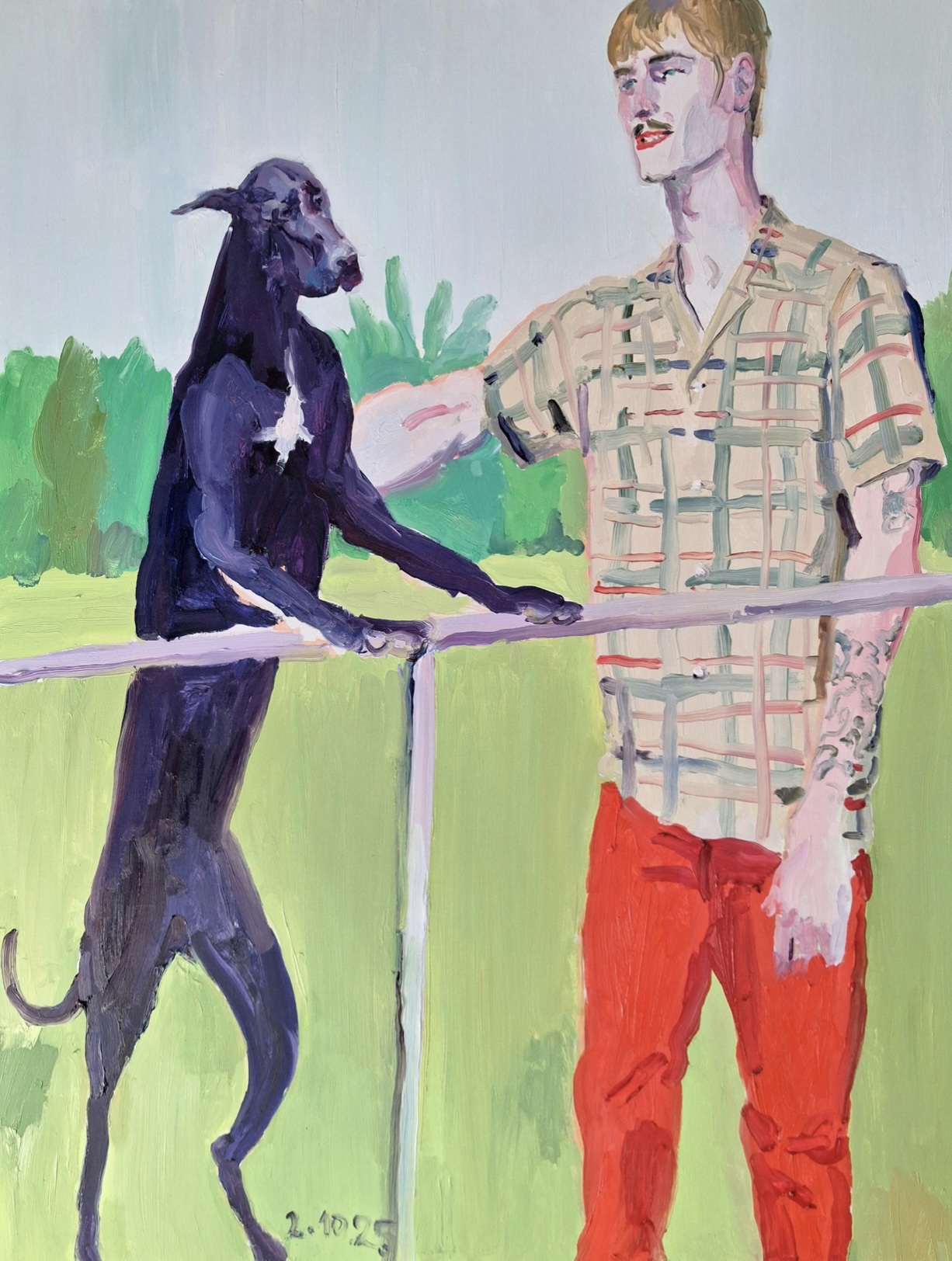
Cinematic references play a central role in shaping this atmosphere. Solà’s work echoes the glamour and tension of 1970s Hollywood and European cinema, particularly Jacques Deray’s La Piscine (1969), in which sun-drenched luxury becomes the backdrop for jealousy, desire, and emotional volatility. Similarly, Solà’s pools and gardens are not neutral spaces; they operate as stages for unspoken inner conflicts. His paintings also recall the poolside photographs of Slim Aarons, which crystallised an idealised vision of affluent leisure. Where Aarons emphasised spectacle and elegance, however, Solà turns inward, using comparable settings to explore vulnerability and self-awareness.
The artist describes the series as a “collective psychological portrait,” a phrase that captures both its cohesion and its openness. Rather than resolving the emotional tensions he introduces, Solà allows them to remain unresolved. This ambiguity is central to the work’s impact, reflecting the contradictions of contemporary life, in which comfort and anxiety often exist side by side.
This sensibility is closely tied to Solà’s biography. Born in Santa Coloma de Farners, Spain, in 1969, he grew up as a self-described homebody, absorbing landscapes largely through cinema rather than direct experience. Films shaped his visual imagination so profoundly that the settings in his paintings often feel more American than Mediterranean. This mediated relationship to place lends his work a slightly unreal quality, as though the scenes exist somewhere between memory, fantasy, and film stills. Solà studied at the Faculty of Fine Arts at the University of Barcelona, graduating in 2007, and now lives and works in Girona, carrying with him a visual language formed as much by screens as by lived experience.
His working process is intuitive and deliberately restrained. Before committing to canvas, Solà produces numerous small drawings, often executed in a single, continuous stroke. These sketches capture fleeting impressions - poses, expressions, compositional rhythms - that he later translates into paint. By working quickly and resisting overworking the surface, he preserves a sense of immediacy and spontaneity. This approach aligns him with figurative painters such as Alice Neel, Lucian Freud, Alex Katz, Chantal Joffe, and Elizabeth Peyton, artists known for distilling emotional essence rather than pursuing photographic precision.
At the core of Solà’s practice is a fascination with unconventional beauty in its many forms. “I fall in love with people who live their beauty without being aware of it,” he says. Some figures are drawn from his personal life; others are constructed from photographs and visual fragments assembled to convey a specific emotional truth. What he seeks is not perfection, but a quiet self-confidence - an ease that feels natural rather than performed. This quality lends his figures a sense of authenticity, even when their surroundings appear stylised or cinematic.
Taken together, the paintings in “Endless Sundays’ read like pages from an intimate summer diary. They capture not events, but states of being: moments of pause, reflection, and subtle disconnection. Viewers are encouraged to drift through these scenes, imagining the relationships between the figures and the invisible tensions shaping their interactions. In doing so, they become participants in the storytelling, completing the narratives Solà intentionally leaves open.
Ultimately, the exhibition affirms Solà’s ability to construct a coherent and compelling visual world - one that is both seductive and introspective. By blending references from art history, cinema, and popular culture, he demonstrates the enduring power of contemporary figurative painting to articulate shared emotional experiences. “Endless Sundays” is less about leisure itself than about the complexities hidden within it, reminding us that even under the brightest sun, interior worlds can remain restless and unresolved.
OPERA GALLERY
1, av. Henri Dunant
Palais de la Scala
operagallery.com
Open
From Monday til Saturday
From 10am til 7pm
The views and opinions expressed herein are the views and opinions of the author and do not necessarily reflect those of The Monegasque™.
Disclosure: The Monegasque™ enhances the editing process with the help of carefully selected AI tools. These tools provide valuable support without taking over the editing process completely, ensuring that the final product is the result of human creativity and expertise augmented by the benefits of enhanced technology. This article is protected under the copyright of The Monegasque™. Unauthorized reprinting, republishing, or rewriting of this content is strictly prohibited without explicit permission from The Monegasque™. Quotations from this material are permissible provided that a direct link to the full article on The Monegasque™ is included.