Cue Princess
IN APRIL 1956, the American actress Grace Kelly married the prince of a faraway country in a fairy-tale wedding - not just once but twice. It’s public knowledge that Grace wed Prince Rainier III of Monaco in a traditional civil ceremony on one day and then in an epic, highly-publicized religious ceremony in a resplendent cathedral on the next. Yet a little-known fact is that on April 18 that same year Grace Kelly also married another prince: Crown Prince Albert of Carpathia. (Oops - that makes three times.)
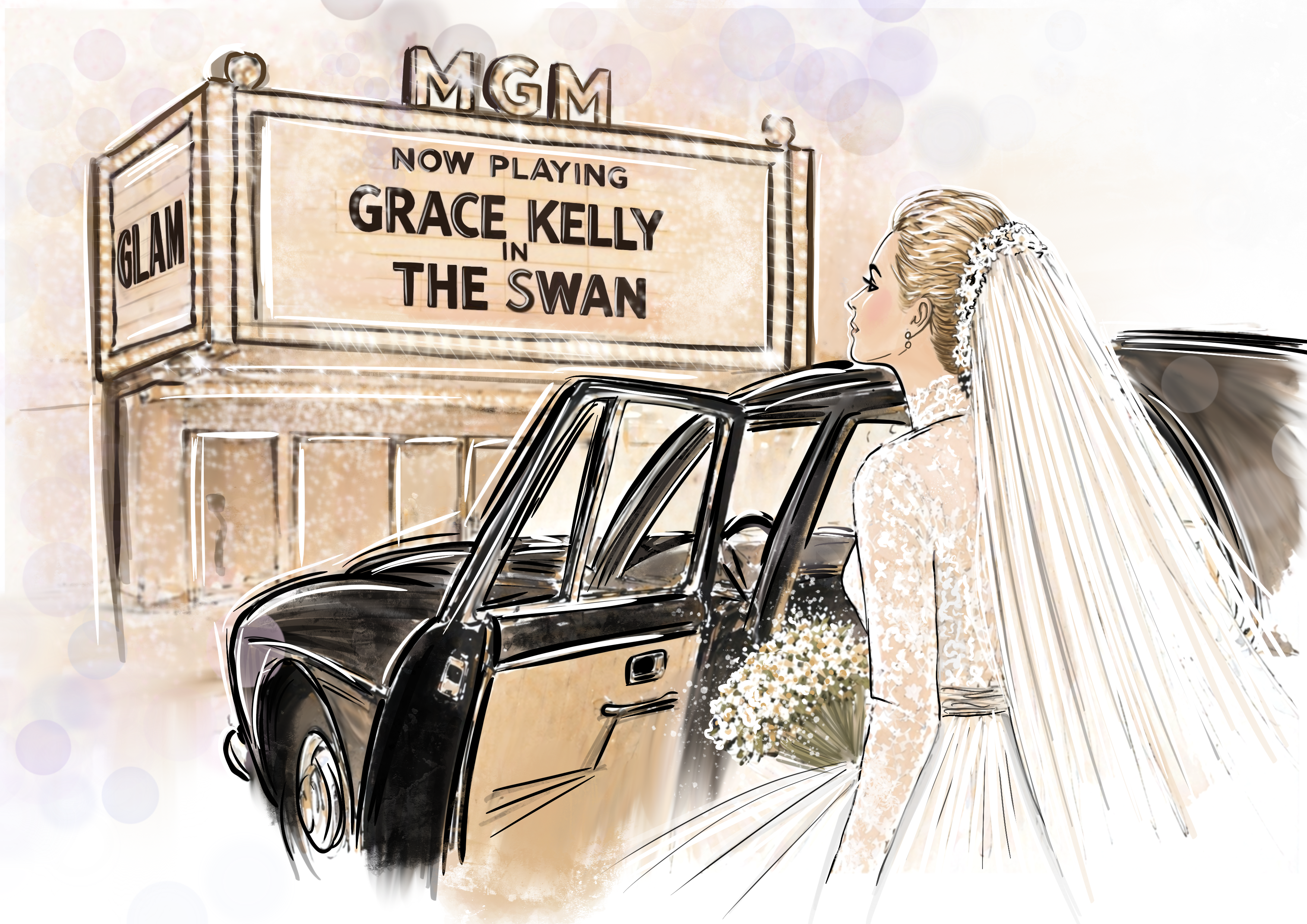
Film lovers will recognize this Prince Albert as the character played by Alec Guinness opposite Grace in The Swan. This MGM film tells the story of a shy aristocratic young woman learning the skills to become - and reluctantly marry - a royal.
Shortly after filming wrapped in late 1955, Grace announced her engagement to Rainier and studio bosses rushed to edit and release the movie to coincide with her civil wedding in Monaco's town hall on April 18, 1956.
Despite the serendipitous publicity boost, The Swan disappointed at the box office. The real event, however, became the “Wedding of the Century.” And whether art imitates life or the reverse, the story of the Grimaldi-Kelly engagement and wedding still reads like a Hollywood screenplay.
The meet-cute
One year before the wedding, Grace Kelly arrived in Cannes to promote The Country Girl, the performance that earned her an Academy Award. The weekly magazine Paris Match had found an opening in Grace’s jam-packed agenda that coincided with a brief - very brief - opportunity to meet Prince Rainier of Monaco for a photo shoot.
On the appointed day, a workers' strike cut electricity across the Riviera. Grace styled herself - damp hair pinned with flowers - and wore a simple non-iron cotton floral dress she had previously modeled for the cover of a sewing magazine.
Racing to the Principality to keep on the tight schedule, Grace was involved in a fender bender when her car was struck from behind by Edward Quinn, a professional photographer assigned to the shoot. FORTUNATELY, no one was hurt and they arrived relatively on time at the Palace. UNFORTUNATELY, the Prince was tied up and would be more than an hour late.
When the pair finally met, the encounter itself was brief - photographs, a walk through the palace zoo, polite conversation - but Grace had found the prince "charming." The couple corresponded for eight months and, when Rainier traveled to the United States in December 1955, he proposed at Christmas in Philadelphia.
The rings
Rainier presented Grace with TWO engagement rings.
The first, revealed in Philadelphia, was a Cartier Eternity ring - a band of rubies and diamonds created from family heirlooms, reflecting Monaco’s red and white flag. It was in fact only a placeholder.
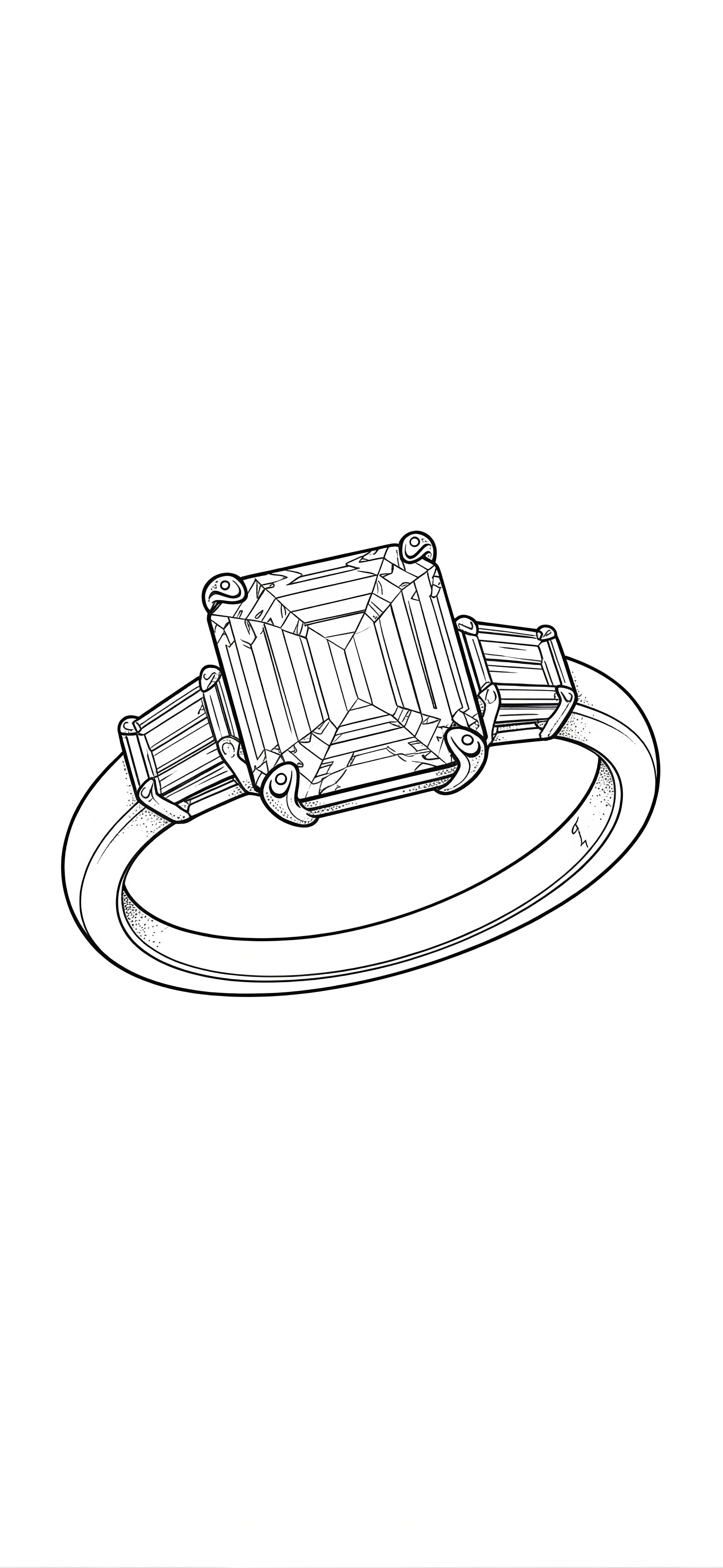
The official ring followed: a 10.47-carat emerald-cut diamond set in platinum, again by Cartier. The ring achieved cinematic immortality when Grace wore it in her last studio film High Society. In one memorable scene she lies on a bed, polishing the stone with a silk sheet before admiring it on her finger - blurring life and fiction elegantly.
There was a third ring: a simple gold wedding band. During the religious ceremony in Monaco's St. Nicholas Cathedral, a visibly nervous Rainier struggled momentarily to place it on Grace's finger. She helpfully guided it over her first knuckle - and a small human moment was witnessed by 30 million television viewers.
The entrance
On April 4, 1956, Grace left New York aboard the SS Constitution with her family, sixty wedding guests and two dogs for an eight-day Atlantic crossing. (The ocean liner would later be featured in the Cary Grant film An Affair to Remember and appeared in episodes of I Love Lucy and Magnum P.I.)
When the Constitution anchored off Monaco harbor on April 12, about 20,000 residents filled the port and streets. Nearly 1,600 journalists from around the world documented the arrival, commandeering helicopters, seaplanes and a flotilla of small boats, which all accompanied Prince Rainier as he sailed to welcome his fiancé on his new yacht, the Deo Juvante, a wedding present from shipping magnate Aristotle Onassis.
The costumes
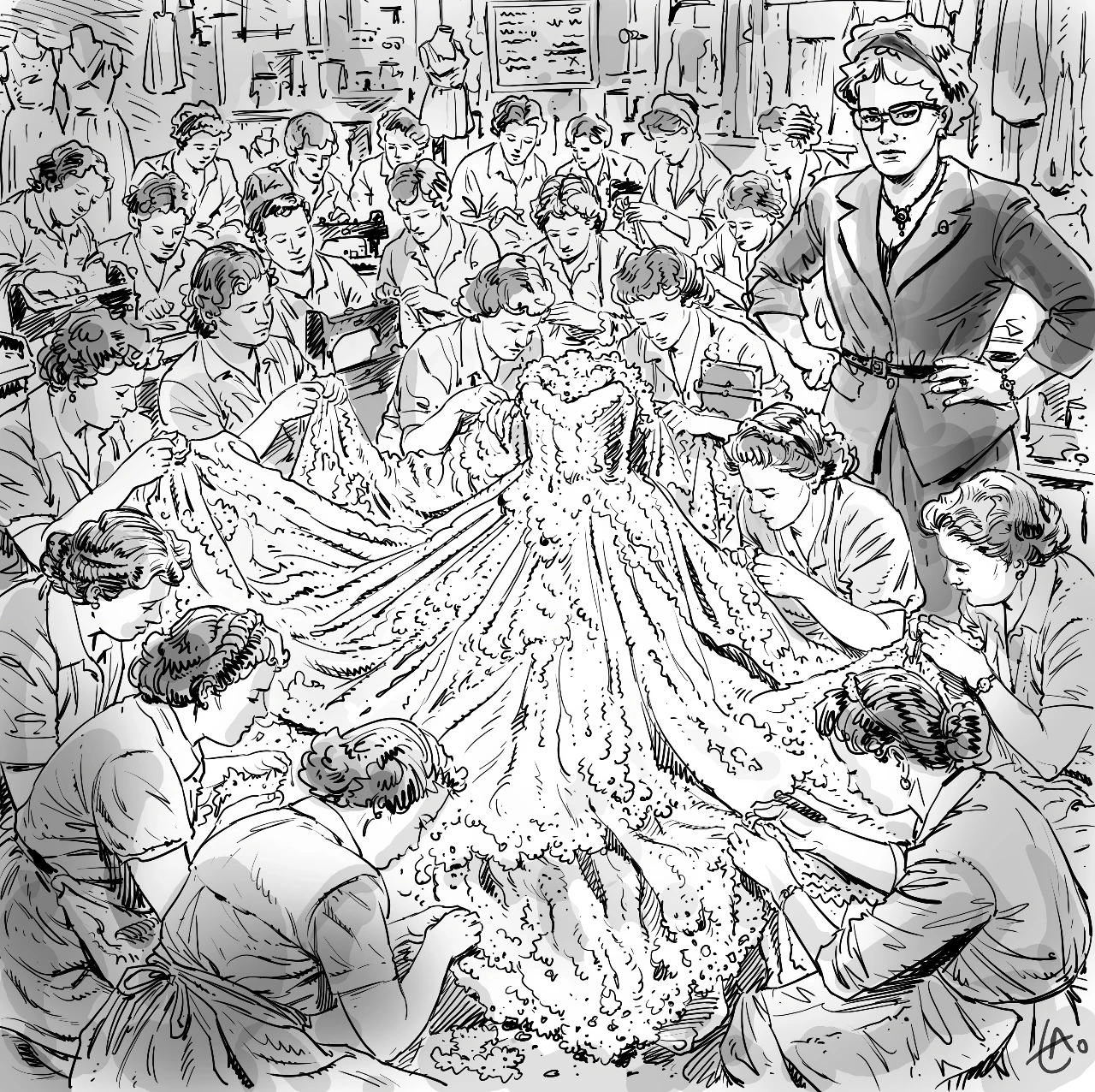
Grace's wedding gown was a gift from MGM, designed by Oscar-winning costume designer Helen Rose. She had previously dressed Grace in both The Swan and High Society.
The dress featured a rounded collar and long sleeves, a fitted bodice of 125-year-old Brussels lace embroidered with seed pearls, and a full ivory peau-de-soie skirt. Twenty-five yards of silk taffeta and one hundred yards of silk net were lovingly stitched by 30 seamstresses over six weeks. The dress would become iconic, redefining bridal elegance worldwide with its timeless, modest sophistication that continues to influence wedding gowns today. (The groom wore a military dress of his own design, based on the uniforms of Napoleon Bonaparte.)
Breaking with traditional custom, Grace chose not to wear a jeweled tiara and opted instead for a lace juliet cap adorned with pearls, anchoring a long veil that left her face framed and visible for cameras.
Her jewelry was also minimal during the religious ceremony - she only wore small pearl earrings.
The gala
This had not been the case the night before, when Grace and Rainier arrived at the Monte Carlo Opera Gala following their civil wedding. The new Princess wore an embellished white silk gown by Lanvin, the oldest Parisian fashion house still in operation. It was embroidered with 800,000 iridescent mother-of-pearl sequins and featured a V-shaped décolleté and a full bustle in the back. Her “accessories” included a Cartier diamond-and-ruby tiara gifted by the Société des Bains de Mer, a diamond festoon necklace, and a Van Cleef & Arpels diamond bracelet from the National Council. She also wore the red and white sash announcing the Order of St. Charles, the Principality's highest chivalric honor.
The bejeweled partygoers and elegant gala atmosphere could have been lifted directly from the Grace Kelly/Cary Grant film To Catch a Thief, as wedding guests staying at the Hôtel de Paris later reported the theft of nearly $50,000 in jewels from their rooms. Unlike the 1955 Hitchcock classic, the thief was never found.
The cast and characters
Nearly 700 guests attended the religious ceremony on April 19 including Hollywood royalty Cary Grant, Ava Gardner, Gloria Swanson, and David Niven, alongside international figures including King Farouk of Egypt, Aristotle Onassis and the Aga Khan III. The mixture of screen legends and global elite underscored the event’s unique status - half royal ceremony, half Hollywood premiere - watched worldwide as one of the first truly modern media weddings.
The finale
Prince Rainier had granted live broadcast rights of the ceremony to French television and Télé-Monte-Carlo via Eurovision, reaching roughly 30 million viewers in nine countries. MGM produced a 30-minute color documentary for American theaters.
Rainier later described the celebrations as “the biggest circus in history,” remarking that he and Grace might have preferred “a little chapel in the mountains,” a wistful comment that suggested the couple felt somewhat swallowed by the massive Hollywood spectacle that their wedding had become. On the other hand, the filming of the wedding introduced global audiences to Monaco, establishing the Principality as a major destination associated with glamour, romance, and sophisticated European culture.
The heightened visibility generated foreign interest and tourism and helped revive Monaco’s fragile post-war economy. Within just a few years, revenues rose dramatically and the Principality's reputation evolved from a niche gambling enclave into a glamorous, fashionable micro-state associated with elegance and luxury lifestyle and culture. More importantly, it established that the Grace Kelly featured in The Swan was no awkward, clueless royal-in-the making but already an elegant, brilliant, and regal princess who would change the country forever.
The views and opinions expressed herein are the views and opinions of the author and do not necessarily reflect those of The Monegasque™.
Disclosure: The Monegasque™ enhances the editing process with the help of carefully selected AI tools. These tools provide valuable support without taking over the editing process completely, ensuring that the final product is the result of human creativity and expertise augmented by the benefits of enhanced technology. This article is protected under the copyright of The Monegasque™. Unauthorized reprinting, republishing, or rewriting of this content is strictly prohibited without explicit permission from The Monegasque™. Quotations from this material are permissible provided that a direct link to the full article on The Monegasque™ is included.