A Yacht By Any Other Name
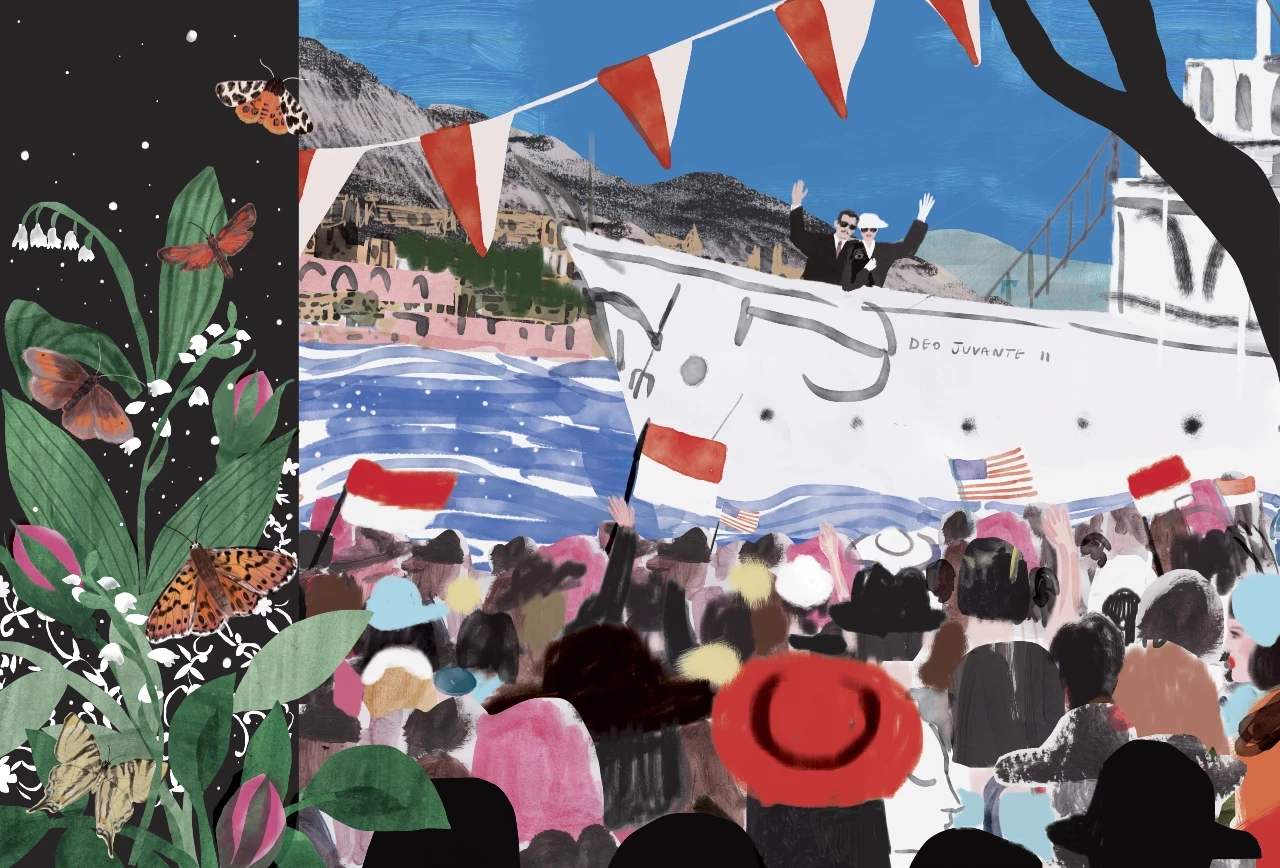
For nearly a century, the Deo Juvante has sailed through oceans and eras, glamour and romance, and adventure and survival. Nine owners charted the iconic yacht in fresh waters, but her identity remains unsinkable.
A WEEK BEFORE her wedding in 1956, Grace Kelly arrived in Mediterranean waters outside the Principality of Monaco. Her future husband, Prince Rainier III, would soon whisk her from the ocean liner SS Constitution aboard his chariot-of-choice, the motor yacht Deo Juvante II.
Sirens, music, and cannon fire filled the port. Overhead, like giant mosquitos, helicopters filmed the arrival for global news organizations. A seaplane belonging to Greek millionaire and Monaco resident Aristotle Onassis dropped thousands of red and white carnations - the colors of Monaco - onto vessels and cheering crowds.
The harbor shimmered with flags and flowers as church bells rang across the cliffs. Dozens of local sailors, along with hundreds of journalists from around the world, launched a patchwork flotilla escorting the Deo Juvante under the direct command of Prince Rainier himself.
For many observers, this historic moment defined the Deo Juvante - a floating symbol of romance, fairy tales, and royalty. Yet by the time she carried the prince to meet his future princess, the Deo Juvante had already navigated through nearly three decades of storms and adventure - with many more to follow. The boat that welcomed Grace to Monaco and hosted the princely honeymoon would serve nine seafaring masters, bear nine different names, and miraculously still thrive today - as the M/Y Grace - in another faraway place.
Constructed in Southampton, England, by Camper & Nicholsons in 1928 and designed as a gentleman’s yacht, she was originally owned by wealthy French-Argentinian entrepreneur Santiago E. Soulas. Her long clipper bow and teak decks gave her the appearance of a small private ship rather than a pleasure craft. Inside were paneled salons, proper dining rooms, and cabins meant for living at sea. Soulas used the boat as a personal shuttle across the Atlantic and named her Monica after his daughter. He held the yacht less than four years before selling her to a Greek-Armenian shipping company owner Zarch Couyoumbian, who renamed her Rion.
Seven years later, the next owner, Sir George Tilly, had no idea that his new luxury excursion yacht would almost immediately be requisitioned by the British Navy and turned into a miniature warship patrolling the English coast during World War II. Stripped of her teak paneling and fine furnishings, HMS Rion was armor-plated and fitted with machine guns and depth charges to hunt German submarines. She was later credited with capturing a high-speed German torpedo boat and an unconfirmed U-boat sinking.
Finally, after sustaining significant damage in combat, the boat's hull was painted white with a large red cross and she served as a hospital ship renamed HMS Noir - Rion spelled backwards.
Following the war, the yacht was finally returned to Tilly. Restored by Camper & Nicholsons to its classic beauty and luxury furnishings, the yacht was soon sold to Aristotle Onassis who had created the world's largest shipping fleet.
Onassis renamed her Arion, likely after the son of Poseidon. He used the yacht to travel independently between Greece, Italy, France, and Monaco while hosting business and political meetings. It was at this time that Onassis began acquiring a major shareholding in Société des Bains de Mer - controller of Monaco’s casinos and hotels.
As his ambitions and relationship with Monaco deepened, Onassis presented the yacht as a wedding gift to Prince Rainier III in 1956.
After the wedding, the royal couple honeymooned briefly in Mallorca before cruising along Corsica and Sardinia. They renamed the yacht Deo Juvante (Monaco’s national motto, “with God’s help”) and entertained friends, celebrities, and heads of state along the French and Italian Rivieras, and used the vessel for family holidays... but only for two years.
In 1958, Prince Rainier sold the yacht to a family friend and Monaco resident Milica Ivanovic, an imperious and larger-than-life Yugoslavian dowager, whom Rainier dubbed “the Queen Mother.” She named the boat Daska after her daughter and eventually the boat would serve her family’s shipping business. Her son Vane Ivanovic, an Olympic hurdler, writer, and political activist, would later be named Monaco’s consul general in London. A descendent of the family still holds the post.
In 1976, Vassilios “Bill” Lefakinis, a pioneer of the Greek charter industry and founder of Valef Yachts, acquired the boat - reportedly signing the contract on a cocktail napkin inside the Athens Hilton. Renamed Angela, after his mother, she toured throughout the Aegean and Mediterranean, hosting the rich and famous, even appearing in Vogue magazine.
During the Lebanese Civil War, the Angela evacuated refugees, and after the 1981 Athens earthquake she sheltered family and crew for months.
Her next owner would be John Issa, Jamaican tourism czar and founder of SuperClubs resorts. Issa integrated the vessel into his “all-inclusive” hospitality concept for nearly 20 years, operating sunset cruises and private charters from Negril and Montego Bay. He renamed her Zein after his daughter.
In 2007, Dolores Gangotena and Eduardo Diez rediscovered the nearly 80-year-old yacht, which was scheduled to be scrapped. The Ecuadorian couple had founded Quasar Expeditions in 1986 and had pioneered sustainable adventure travel in the Galápagos Islands. They instantly recognized the yacht’s legacy, renaming her Grace. Using original blueprints, they undertook a comprehensive restoration to bring back her historic elegance while making her suitable for modern expedition cruising.
The Galápagos Islands are an essential wildlife sanctuary because their isolation fostered uniquely evolved species found nowhere else on Earth, making them one of the world's most important living laboratories of biodiversity and conservation. Today, in her most recent reinvention, The M/Y Grace hosts expert-led Galápagos expeditions that combine close encounters with wildlife and strict conservation practices, emphasizing low-impact travel, environmental education, and active support for the protection of fragile island ecosystems.
Today she sails not merely as a preserved relic of the past, but as a living legacy: elegance strengthened by resilience. Like her current namesake Princess Grace, she is an eternal classic.
The views and opinions expressed herein are the views and opinions of the author and do not necessarily reflect those of The Monegasque™.
Disclosure: The Monegasque™ enhances the editing process with the help of carefully selected AI tools. These tools provide valuable support without taking over the editing process completely, ensuring that the final product is the result of human creativity and expertise augmented by the benefits of enhanced technology. This article is protected under the copyright of The Monegasque™. Unauthorized reprinting, republishing, or rewriting of this content is strictly prohibited without explicit permission from The Monegasque™. Quotations from this material are permissible provided that a direct link to the full article on The Monegasque™ is included.